

BOKU University in Vienna was founded in 1872 and specializes in sustainability and the management of natural resources. As one of Europe’s leading life sciences universities, BOKU University combines the natural sciences, engineering, and economics.
For BOKU University and the Institute of Hydrology and Water Management (HyWa), a long-standing research partnership at this location had already served as an important foundation for successfully securing an FWF-DFG-Weave project and an ERC Synergy Grant. Both projects are currently coordinated by Assoc. Prof. Dr. Franziska Koch from HyWa and carried out in cooperation with UFS and other international partners. In addition to alpine hydrology, the research topics being explored by BOKU University—which can be implemented at the Zugspitze—are highly diverse and encompass not only the hydrosphere and cryosphere but also the geosphere, biosphere, and atmosphere. For BOKU University’s HADRIAN (Hazards and Risks in Alpine Regions under Global Change) doctoral school, UFS has already served as the venue for an annual retreat and will become an important location for joint research and the further development of the doctoral school in the future.
Information on current projects:

Seasonal snowpack is a key climate variable and is of crucial importance for the water cycle and the well-being of billions of people worldwide. Quantifying snow cover and estimating its spatial and temporal distribution is currently considered one of the most important challenges in Alpine hydrology. Furthermore, it is very difficult to characterize other components of Alpine water reservoirs (e.g., karst reservoirs) and their relationships with precipitation, evapotranspiration, and runoff processes.
The FWF-DFG Weave research project G-MONARCH combines gravimetric methods with in situ and remote sensing monitoring, as well as snow-karst-hydrological modeling, to improve our understanding of the Alpine water balance in general and specifically using the Zugspitze as a case study. The Zugspitze Geodynamic Observatory Germany (ZUGOG) operated by the GFZ Helmholtz-Zentrum for Geosciences—with its globally unique installation of a superconducting gravimeter on the summit of the Zugspitze above a highly instrumented, high-alpine, snow-rich watershed—is thus being used as a novel hydrological sensor system for the direct, comprehensive, and non-invasive observation of the gravitational effect of water storage variations. The major innovation lies in the fact that all changes in hydrological mass within a radius of approximately 5 km around the gravimeter can be comprehensively recorded and quantified. The Zugspitze is thus “weighed” virtually continuously: When it snows, it becomes “heavier,” and when snow and ice melt, it becomes “lighter.”
Researchers from BOKU University, the GFZ Helmholtz Centre for Geosciences in Potsdam, the Technical University of Berlin, and the University of Augsburg, as well as the Environmental Research Station Schneefernerhaus (UFS) and other national and international partners, are participating in the project.
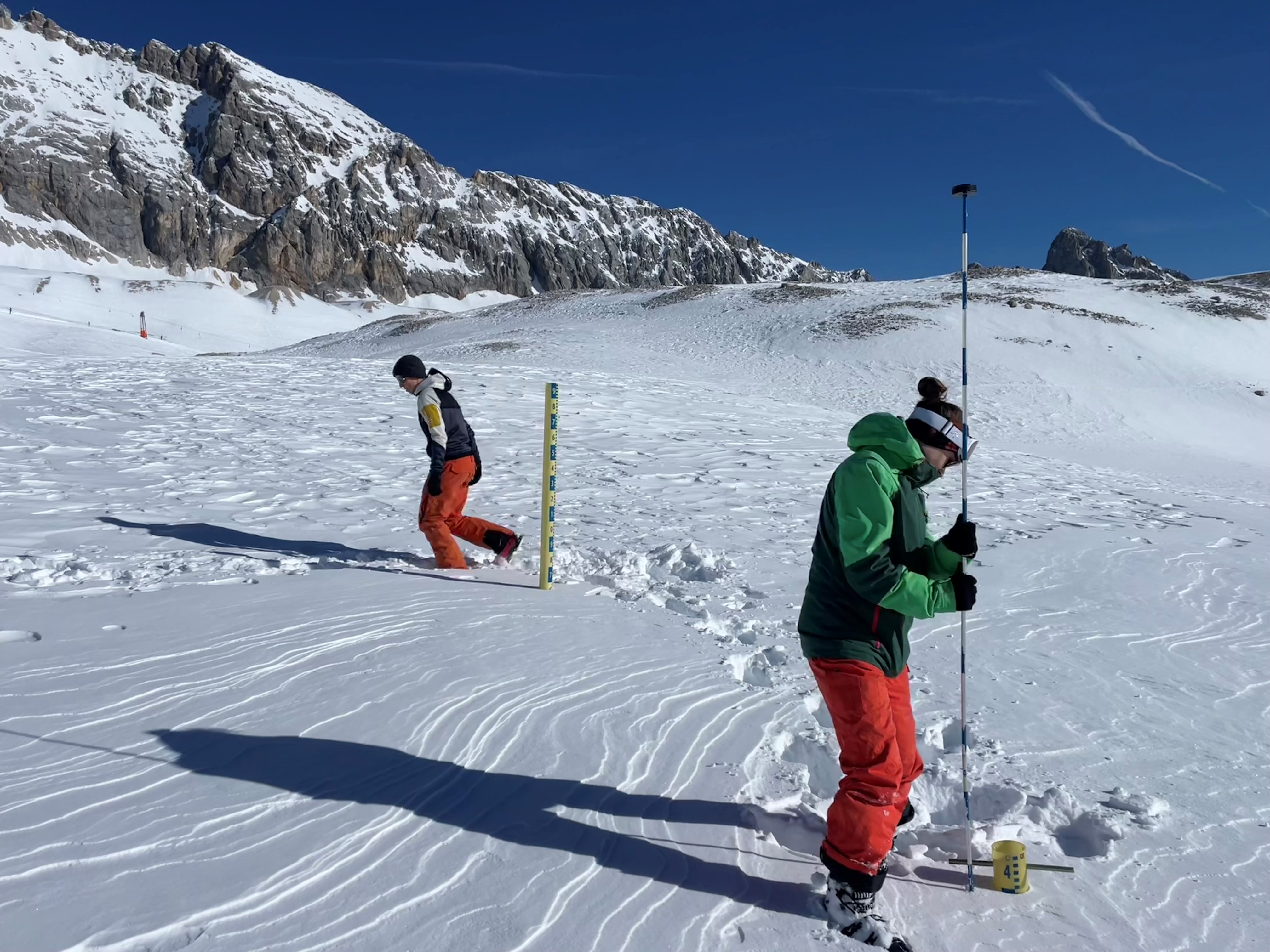
The UN Decade of Action for Cryosphere Sciences aims to reduce uncertainties regarding the causes and impacts of changes in snow, ice, and permafrost. Snow contributes significantly to these uncertainties, as snow processes cannot yet be fully understood or represented in climate models. The ERC Synergy Project SnowShifts aims to significantly improve our understanding of snow volume and mass, their nonlinear dynamics and properties, and, in particular, changes in snow regimes within Earth and climate systems. Together with partners, this will be achieved through a novel combination of in-situ and remote sensing monitoring, as well as through the development of advanced numerical models. Innovative technologies such as photon-counting satellite-based laser altimeters, ground-based superconducting gravimeters, and GNSS sensors, as well as novel approaches to scale bridging and downscaling of satellite gravimetry data in extreme regions, will be combined with the latest multisensor satellite data and modeling. This enables the determination of snow volume, mass, extent, and other properties—such as snow albedo—with unprecedented spatial and temporal resolution, as well as the detection of trends and changes in the snow climate ranging from polar regions to high-mountain regions in mid-latitudes.
BOKU University is collaborating closely on this project with the principal investigators (PIs) from the University of Oslo in Norway and EPFL Lausanne/SLF Davos in Switzerland, as well as with the project’s partners, such as the GFZ Helmholtz Centre for Geosciences in Potsdam. A particularly important in situ supersite in the project is the Zugspitze, where the BOKU University team, led by PI Franziska Koch, is conducting intensive snow hydrology research. We are pleased to support the scientists in their interdisciplinary project.